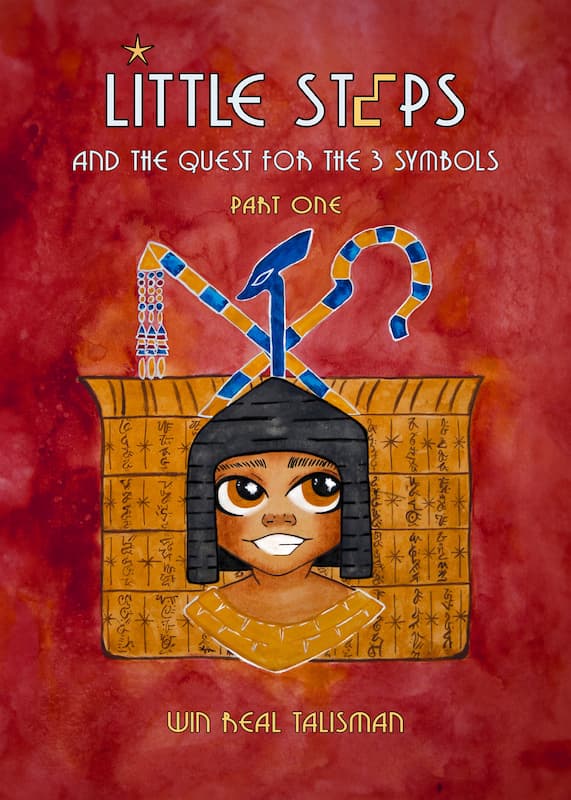
Win Real Talisman is an anagram of my full name. I was really intrigued by what it meant. In the end I elected to give it meaning by choosing to use it as my author’s name. My goal was to win the hearts and imagination of every reader, in other words, to win the real talisman
 I wanted to create a symbol based on geometric shapes and came up with the idea of converting the letters in Win Real Talisman to sides, so that the 3 letters of Win became the triangle, the 4 letters of Real the square and the eight letters of Talisman the octagon. With the positioning of the components and adding different colour it reminds me of the black basalt steps leading up to the Great Pyramid of Giza in its original white Tura limestone casing stones.
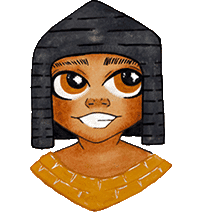 Little Steps is a 10 year old Egyptian boy in the time of Pharaoh Hatshepsut and he is on the quest for the 3 symbols. He is joined on his adventure by his 3 extraordinary friends: Red Brick, the Giant; Axiom, the Centaur and Lapis, the Vulture.
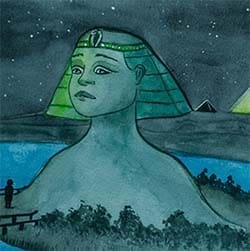 Hatshepsut was a Pharaoh and Queen from the 18th Dynasty whose funeral temple is located at Deir-el-Bahari, and only one of 2 known female Pharaohs. She was almost completely lost to history as her step-son Thutmose III did his best to erase her existence, altering historical records, removing her image from temple scenes and destroying her statues. Her 22 year reign was one of prosperity and peace, reestablishing key trade routes and importing myrrh trees from Punt. I was fortunate enough to see her surviving statues when I visited the Met Museum in New York in 2019. As a historical character Hatshepsut has always fascinated me.
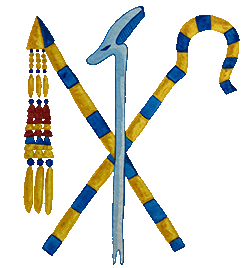 The 3 symbols of ancient Egypt are the Staff, the Flail and the Crook. Challenges must be faced and overcome to win each symbol in turn and understanding must be gained before the 3 symbols can be united. The Staff represents the balance of the body. The Flail represents the balance of the mind and the Crook represents the balance of emotions.
It was around 2000 that Little Steps first entered my imagination and took form. At the time I was studying for my masters at Cornell University. At that stage all I knew was that Little Steps was a young Egyptian boy in the time of Pharaoh Hatshepsut. The essence of the story was his dissatisfaction with his name – when he wanted to achieve great things, he felt his name was against him, but over the course of time he begins to understand that it is only by taking little steps and being true to his name that greatness is achieved. The idea of a quest, his fabulous friends and the journey to find balance came much later and after a lot more research about ancient Egypt. Little did I know it would be another 20 years before I had the time, drive, skills and resources to set off on my own writing adventure and bring the story to life.
The story is based on the ancient initiation ceremony of the importance of understanding and achieving harmony by balancing the body, mind and emotions. As Little Steps discovers on his journey it is one thing to achieve balance in any given moment, but another completely to be able to maintain it. Often in Egyptian art you will see the Pharaoh holding the 3 symbols – the Staff, the Crook and the Flail. The challenges and lessons are unique for each symbol.
There are 3 parts to the story. In Part 1 you are introduced to the main characters as Little Steps learns about the quest he is to embark upon and the friends make their way from Buhen in the south to the temple complex at Karnak in an air-barque. And on that ride Axiom, the great storyteller weaves a tale straight out of Egypt’s golden age. Having arrived at Karnak it is time to learn the lessons and to face the challenges of the First Symbol – the Staff. This part of the journey takes the friends from Karnak all the way to Abusir, the School of Learning, not far from Giza.
In Part 2 the friends meet the incredible Professor Zero who guides them through various challenges associated with the balance of the mind with the action focused mainly at Abusir, but ends with a journey to Giza, where riddles must be solved before Little Steps can meet Pharaoh Hatshepsut at Abu Garab.
In the trilogy finale Little Steps must face his greatest challenge yet with the help of the Master of Balance, Spectrum – to balance emotions and win the final symbol, the Crook. He must also face a solo challenge to navigate and escape the great labyrinth at Sakkara. The trilogy concludes with the closing ceremony at Deir-el-Bahari.
Yes! The entire book is written in haiku, which for anyone unfamiliar with this form of poetry originates from Japan and consists of 3 lines of 5 syllables, 7 syllables and 5 syllables. An example being the opening haiku for the story:
Once upon a time
Time past, but not forgotten
His story begins
Firstly I don’t believe this has ever been done before and I liked the idea of setting myself a challenge as part of the writing process. Secondly, I am a lawyer by vocation, and used to writing long sentences, and I wanted the discipline of writing the story in a verse format, partly to ensure a uniform flow, partly to add to the sense of an old world fairytale and partly to be very concise and deliberate with the words I used.
Yes. I met Rula for the first time in late 2023 and her passion and excitement for Little Steps inspired me to think about where to go with the story and characters – in short she acted as a muse! For the next 2 weeks I let my imagination loose and was able to capture the plot, backbone of the story and ending to revisit at a later date...
That is a great question! I’ve been writing poetry for many years and always loved haiku. It has been a personal ambition of mine to write a book, and in truth I’ve started many projects and often found myself saying that I was writing a book, so in a way you could say writing the book was a personal quest. I remember flying back from the US to London feeling particularly inspired and I had the sense of looking at the journey from both ends. From one side I was looking forward thinking of starting, and on the other side I had already written the book and was looking back at the journey. I realised that I had amassed many organisational skills throughout my career and I had the epiphany of running it like a project plan and trusting my intuition and creative skills to deliver in the same way as my organisational skills. Completing the story represents a huge personal milestone and is as many writers will tell you a truly cathartic experience.
Authenticity and being true to your word are key themes of the book. The lessons that the characters learn are universal and the central theme of the importance of balance resonates just as much today as it did in the time of Hatshepsut. In a society where being true to your word is undervalued and perception is considered everything the lessons of the book are not only timeless but a welcome change to a world where convincing someone that what you are saying is true is considered more important than showing that your words and actions align.
Rest assured Part 2 and Part 3 have been written and edited and are just pending completion of the new book covers. The audio versions of Part 2 and Part 3 have already been recorded and all 3 books are fully illustrated, digital and ready for final formatting. In addition Lorra Ley and I created an amazing audio-visual version for Part 1, but to find out more and see sneak peeks please subscribe to the newsletter https://winrealtalisman.com/subscribe/
You can send a message and get in touch via the Contact page https://winrealtalisman.com/contact/ but, the best way to stay up to date on all the latest developments and get access to exclusive content is to subscribe to the newsletter https://winrealtalisman.com/subscribe/